POLYNOMIALS

Polynomials

A polynomial looks like this:

polynomial example
example of a polynomial
this one has 3 terms

Polynomial comes from poly- (meaning "many") and -nomial (in this case meaning "term") ... so it says "many terms"

A polynomial can have:

constants (like 3, -20, or ½)
variables (like x and y)
exponents (like the 2 in y2), but only 0, 1, 2, 3, ... etc are allowed
that can be combined using addition, subtraction, multiplication and division ...

... except ...

... not division by a variable (so something like 2/x is right out)
So:

A polynomial can have constants, variables and exponents,
but never division by a variable.

Polynomial or Not?


polynomial
These are polynomials:


  • 3x
  • x - 2
  • -6y2 - (7/9)x
  • 3xyz + 3xy2z - 0,1xz - 200y + 0,5
  • 512v5+ 99w5
  • 5
(Yes, even "5" is a polynomial, one term is allowed, and it can even be just a constant!)
And these are not polynomials

  • 3xy-2 is not, because the exponent is "-2" (exponents can only be 0,1,2,...)
  • 2/(x+2) is not, because dividing by a variable is not allowed
  • 1/x is not either
  • √x is not, because the exponent is "½"
But these are allowed:

  • x/2 is allowed, because you can divide by a constant
  • also 3x/8 for the same reason
  • √2 is allowed, because it is a constant (= 1,4142...etc)

Monomial, Binomial, Trinomial

There are special names for polynomials with 1, 2 or 3 terms:

monomial, binomial, trinomial

How do you remember the names? Think cycles!
mono tri bi

There is also quadrinomial (4 terms) and quintinomial (5 terms),
but those names are not often used.

Can Have Lots and Lots of Terms

Polynomials can have as many terms as needed, but not an infinite number of terms.

Variables

Polynomials can have no variable at all

Example: 21 is a polynomial. It has just one term, which is a constant.
Or one variable

Example: x4-2x2+x has three terms, but only one variable (x)
Or two or more variables

Example: xy4-5x2z has two terms, and three variables (x, y and z)

What is Special About Polynomials?

Because of the strict definition, polynomials are easy to work with.
For example we know that:

So you can do lots of additions and multiplications, and still have a polynomial as the result.

You can also divide polynomials (but the result may not be a polynomial).

Degree

The degree of a polynomial with only one variable is the largest exponent of that variable.

Example:

4x3-x-3 The Degree is 3 (the largest exponent of x)
For more complicated cases, read Degree (of an Expression).

Standard Form

The Standard Form for writing a polynomial is to put the terms with the highest degree first.


Example: Put this in Standard Form: 3x2 - 7 + 4x3 + x6

The highest degree is 6, so that goes first, then 3, 2 and then the constant last:

x6 + 4x3 + 3x2 - 7


POLYNOMIALS OPERATIONS


Reading Fractions


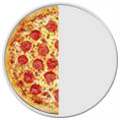
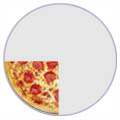
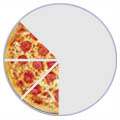
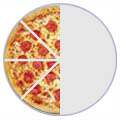
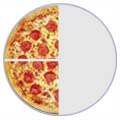
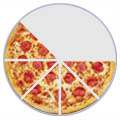
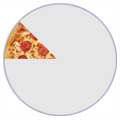
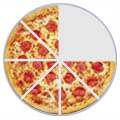
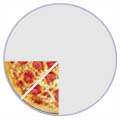
Slice a pizza, and we get fractions:

pie 1/2pie 1/4pie 3/8
1/21/43/8
(One-Half)
(One-Quarter)
(Three-Eighths)
The top number says how many slices we have. 
The bottom number says how many equal slices the whole pizza was cut into.

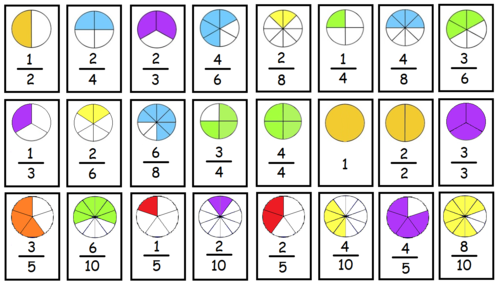
Some fractions may look different, but are really the same, for example: 


4/8=2/4=1/2
(Four-Eighths) (Two-Quarters) (One-Half)
pie 4/8=pie 2/4=pie 1/2
It is usually best to show an answer using the simplest fraction ( 1/2 in this case ). That is calledSimplifying, or Reducing the Fraction

Numerator / Denominator

We call the top number the Numerator, it is the number of parts we have.
We call the bottom number the Denominator, it is the number of parts the whole is divided into.
NumeratorDenominator
You just have to remember those names! (If you forget just think "Down"-ominator)

Adding Fractions

It is easy to add fractions with the same denominator (same bottom number):
1/4+1/4=2/4=1/2
(One-Quarter) (One-Quarter) (Two-Quarters) (One-Half)
pie 1/4+pie 1/4=pie 2/4=pie 1/2
One-quarter plus one-quarter equals two-quarters, equals one-half
Another example:
5/8+1/8=6/8=3/4
pie 5/8+pie 1/8=pie 6/8=pie 3/4
Five-eighths plus one-eighth equals six-eighths, equals three-quarters

Adding Fractions with Different Denominators

But what about when the denominators (the bottom numbers) are not the same? 
3/8+1/4=?
pie 3/8+pie 1/4=pie huh
Three-eighths plus one-quarter equals ... what?
We must somehow make the denominators the same.
In this case it is easy, because we know that 1/4 is the same as 2/8 :
3/8+2/8=5/8
pie 3/8+pie 2/8=pie 5/8
Three-eighths plus two-eighths equals five-eighths

Solving math word problems


Addition
add(ed) to
all together
both
combined
in all
increase by
more than
perimeter
plus
sum
total
Subtraction
decreased by
difference
fewer than
how many more
left
less
less than
minus
remaining
take away
Multiplication
a
area
multiplied by
of
per
product of
rate
times
triple
twice
Division
divided 
half
how many each
out of
percent
quarter
quotient of
percent

Solving math word problems

There are two steps to solving math word problems:
  1. Translate the wording into a numeric equation
    that combines smaller "expressions"
  2. Solve the equation!
Suggestions:
  • Read the problem entirely
    Get a feel for the whole problem
  • List information and the variables you identify
    Attach units of measure to the variables (gallons, miles, inches, etc.)
  • Define what answer you need,
    as well as its units of measure
  • Work in an organized manner
    Working clearly will help you think clearly
    • Draw and label all graphs and pictures clearly
    • Note or explain each step of your process;
      this will help you track variables and remember their meanings
  • Look for the "key" words (above)
    Certain words indicate certain mathematical operations:
Math expressions (examples):
after you review the keywords, test yourself
addition: 5+xsubtraction: 5-x
multiplication: 5*x; 5xdivision: 5 ÷ x; 5/x
Exercise: ("mouse over" the block for answer)
Key words for addition + increased by; more than; combined together; total of; sum; added to
What is the sum of 8 and y?
8 + y
Express the number (x) of apples
increased by two
x + 2
Express the total weight of
Alphie the dog (x) and Cyrus the cat (y)
x + y
Key words for Subtraction 
less than, fewer than, reduced by, decreased by, difference of
What is four less than y
y - 4
What is nine less than a number (y)
y - 9
What if the number (x) of pizzas
was reduced by 6?
x - 6
What is the difference of my weight (x)
and your weight (y)
x - y
Key words for multiplication * x or integers next to each other (5y, xy):of, times, multiplied by
What is y multiplied by 13
13y or 13 * y
Three runners averaged "y" minutes.
Express their total running time:
3y
I drive my car at 55 miles per hour.
How far will I go in "x" hours?
55x
Key words for division ÷ / per, a; out of; ratio of, quotient of; percent (divide by 100)
What is the quotient of y and 3
y/3 or y ÷ 3
Three students rent an apartment
for $ "x" /month. What will each have to pay?
x/3 or x ÷ 3
"y" items cost a total of $25.00.
Express their average cost:
25/y or 25 ÷ y
More vocabulary and key words:
  • "Per" means "divided by"
    as "I drove 90 miles on three gallons of gas, so I got 30 miles per gallon."
    (Also 30 miles/gallon)
  • "a" sometimes means "divided by"
    as in "When I filled up, I paid $10.50 for three gallons of gasoline,
    so the gas was 3.50 a gallon, or $3.50/gallon
  • "less than"
    If you need to translate "1.5 less than x", the temptation is to write "1.5 - x". DON'T! Put a "real world" situation in, and you'll see how this is wrong: "He makes $1.50 an hour less than me." You do NOT figure his wage by subtracting your wage from $1.50.
    Instead, you subtract $1.50 from your wage
  • "quotient/ratio of" constructions
    If a problems says "the ratio of x and y",
    it means "x divided by yor x/y or x ÷ y
  • "difference between/of" constructions
    If the problem says "the difference of x and y",
    it means "x - y"

What if the number (x) of children was reduced by six, and then they had to share twenty dollars? How much would each get?
20/(x - 6)
What is 9 more than y?
y + 9
What is the ratio of 9 more than y to y?
(y + 9)/y
What is nine less than the
total of a number (y) and two
(y + 2) - 9 or  y - 7
The length of a football field is 30 yards more than its width "y". Express the length of the field in terms of its width y
y + 30


DECIMALS - 1ºESO


1. Candy is on sale 5 pounds for $9.95. Find the price per unit.
  1. $10.00
  2. $5.02
  3. $1.99
  4. $0.50
2. If candy is $4.25 per pound, how much would 3 pounds cost?
  1. $12.75
  2. $0.71
  3. $1.28
  4. $1.42
3. Ruby has $10. She buys a bottle of water for $1.29 and a bracelet for $5.95. How much change will she get back at the register?
  1. $2.76
  2. $7.24
  3. $3.24
  4. no change
4. At a clothing store, T-shirts are on sale for $9.97 each. What is the cost for 3 shirts?
  1. $29.91
  2. $27.91
  3. $3.32
  4. $12.9
5. Find the sum of 34.2 and 5.374.
  1. 39.574
  2. 28.826
  3. 5.716
  4. 185.7908
6. The student council bought 7 bags of apples for their fall party. Bags of apples were on sale for $3.45 each. How much did they pay for the apples?
  1. $24.15
  2. $0.49
  3. $23.85
  4. None of the above
7. One of the first helicopters flew at a speed of 44.7 km per hour. At this speed, ABOUT how far could the helicopter travel in 2.75 hours?
  1. A little more than 135 km.
  2. Exactly 135 km.
  3. 47.45 km
  4. A little less than 135 km.
8. A muffin recipe calls for 0.75 cups of blueberries. Paul is making 5 batches. He already has 2.5 cups of blueberries. How many more cups does he need?
  1. 1 1/2 cups
  2. 3.25 cups
  3. 3.75 cups
  4. 1.25 cups

Fibonacci Sequence


FIBONACCI PIANO - MUSIC

Agentes geológicos externos.


http://recursos-itaca.blogspot.com/2016/02/agentes-geologicos-externos.html


Los agentes geológicos externos (atmósfera, hielo, aguas superficiales, aguas subterráneas y seres vivos) modifican el relieve y el paisaje mediante procesos de meteorización, erosión, transporte y sedimentación.
El viento arrastra partículas en suspensión y modela el relieve. Los glaciares se desplazan lentamente por la superficie terrestre. Los ríos erosionan, transportan materiales y los depositan en sus desembocaduras. Las aguas subterráneas se almacenan formando acuíferos. Las aguas marinas ejercen mediante las olas, mares y corrientes una triple acción: erosión, transporte y sedimentación que dan lugar a estructuras características en las zonas costeras.
La Tierra se modela por la acción de los agentes geológicos externos. El agua, en sus diferentes formas, y el viento, transforman el paisaje.
El agua cuando cae en forma de precipitaciones arrastra materiales, ya sea cuando discurre en forma de aguas de arroyada, torrentes o formando ríos. Si se infiltra en el terreno forma acuíferos, si los materiales lo permiten.
Cuando las rocas son solubles, el agua las disuelve y forma estructuras espectaculares.
Si la temperatura es muy baja, el agua forma glaciares que avanzan lentamente por los valles.
El agua de los mares y océanos va esculpiendo las costas, proporcionándonos agradables playas e impresionantes acantilados.
El viento actúa sobre las regiones áridas del planeta, que no tienen una cubierta vegetal que les proteja de su acción. Las rocas adquieren formas fabulosas y aparecen mares de arena que avanzan poco a poco.

El Método Científico

El método científico es un método de investigación usado principalmente en la producción de conocimiento en las ciencias. Para ser llamado científico, un método de investigación debe basarse en lo empírico y en la medición, sujeto a los principios específicos de las pruebas de razonamiento. Es decir, es una secuencia de pasos que nos permiten explicar hechos o fenómenos de la naturaleza a través de una actividad científica, ellos son:

  1. Observación: Es aplicar atentamente los sentidos a un objeto o a un fenómeno, para estudiarlos tal como se presentan en realidad, puede ser ocasional o causalmente.
  2. Inducción o problema: estas observaciones generan dudas y preguntas que llevan al planteo de un problema.
  3. Hipótesis: Elaborar una explicación provisional de las observaciones o experiencias y sus posibles causas.
  4. Probar la hipótesis por experimentación.
  5. Demostración o refutación (antítesis) de la hipótesis: Es el resultado de la experimentación, de nuevas observaciones, mediciones o indagaciones a través de un experimento o búsqueda de información en libros, revistas, entrevistas, etc. Ahora, estos datos obtenidos durante la actividad de investigación, tendremos que organizarlos en cuadros gráficos, esquemas, diagramas, fotos, etc.
  6. Tesis o teoría científica: Si comprobamos que la hipótesis planteada es verdadera, nuestra conclusión será VALIDA; en caso de que los hechos investigados no coincidan con la hipótesis, esta será NO VALIDA, por lo que tendremos que replantear la hipótesis. una secuencia de pasos que nos permiten explicar hechos o fenómenos de la naturaleza a través de una actividad científica.


En la vida cotidiana aplicamos muchas veces el Método Científico aún en forma intuitiva.

Veamos algunos ejemplos cotidianos sencillos:

Imagina que te sientas en el sofá dispuesto a ver un rato la televisión y al apretar el control remoto para encender, la tele no se enciende. Repites la operación tres veces y nada.

Observación: La tele no se enciende
Problema: El control remoto no funciona porque las pilas están agotadas
Hipótesis: La solución consiste en poner pilas nuevas
Predicción de resultados: Si cambio las pilas la tele encenderá.
Experimento: Quito las pilas antiguas y pongo nuevas. La tele enciende.
Conclusión: Se confirmó la hipótesis.

Si después del cambio de pilas la tele sigue sin encender entonces planteas una nueva hipótesis.

Problema: El control remoto está dañado. 
Hipótesis: Debo actuar directamente en la botonera de la tele.
Predicción de resultados: Si acciono el botón de arranque encenderá.
Experimento: Acciono el botón de arranque y se encendió.
Conclusión: Se confirmó que el control remoto está fallado.

Si no hubiera encendido, razonaré que el problema es la falta de corriente eléctrica.

Problema: No llega corriente eléctrica a la tele.
Hipótesis: Hay corte de luz.
Predicción de resultados: Si acciono cualquier perilla nada sucederá.
Experimento: Acciono una perilla cualquiera y nada enciende.
Conclusión: Se confirmó la hipótesis.

Si en cambio la luz hubiera encendido el problema está en el interior del aparato y debe llamar al service. Como se ve en estos casos sencillos, ante la aparición de un problema solemos aplicar intuitivamente el Método Científico para buscar una solución.


HLD 1°AB - Ready, steady,...go!

Doodle Art Alley have educational, motivational, and inspirational quotes "doodled" just waiting to be filled in.

I was soo impressed with how hard the students worked on these and how beautiful they turned out.